
Poster im Bundestag

Academic freedom: freedom to research. Undergraduate research on show in the German Bundestag.

Poster im Bundestag

Venue

Paul-Löbe-Haus, German Bundestag, Berlin

Dates

25 June to 17 July 2026

About

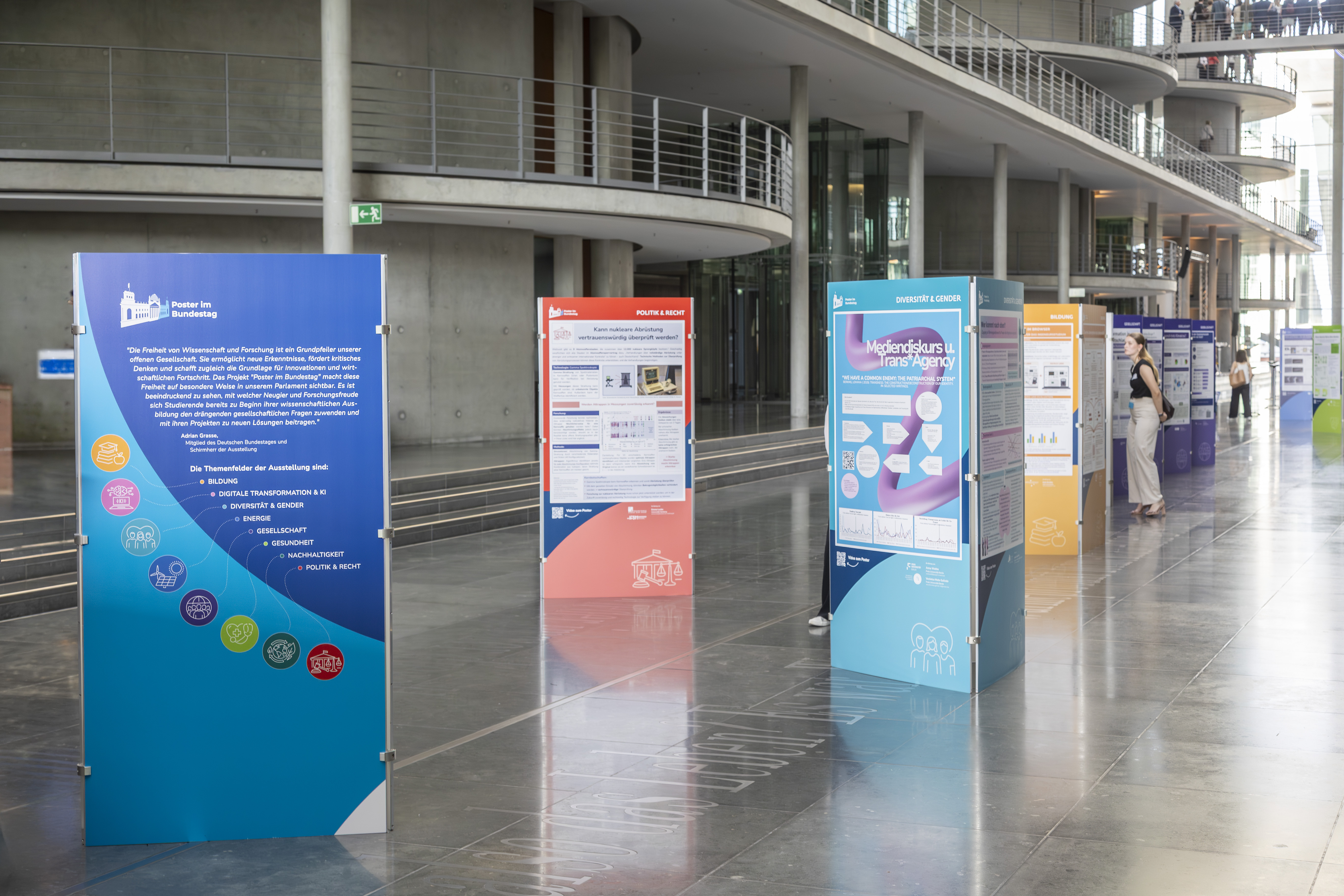
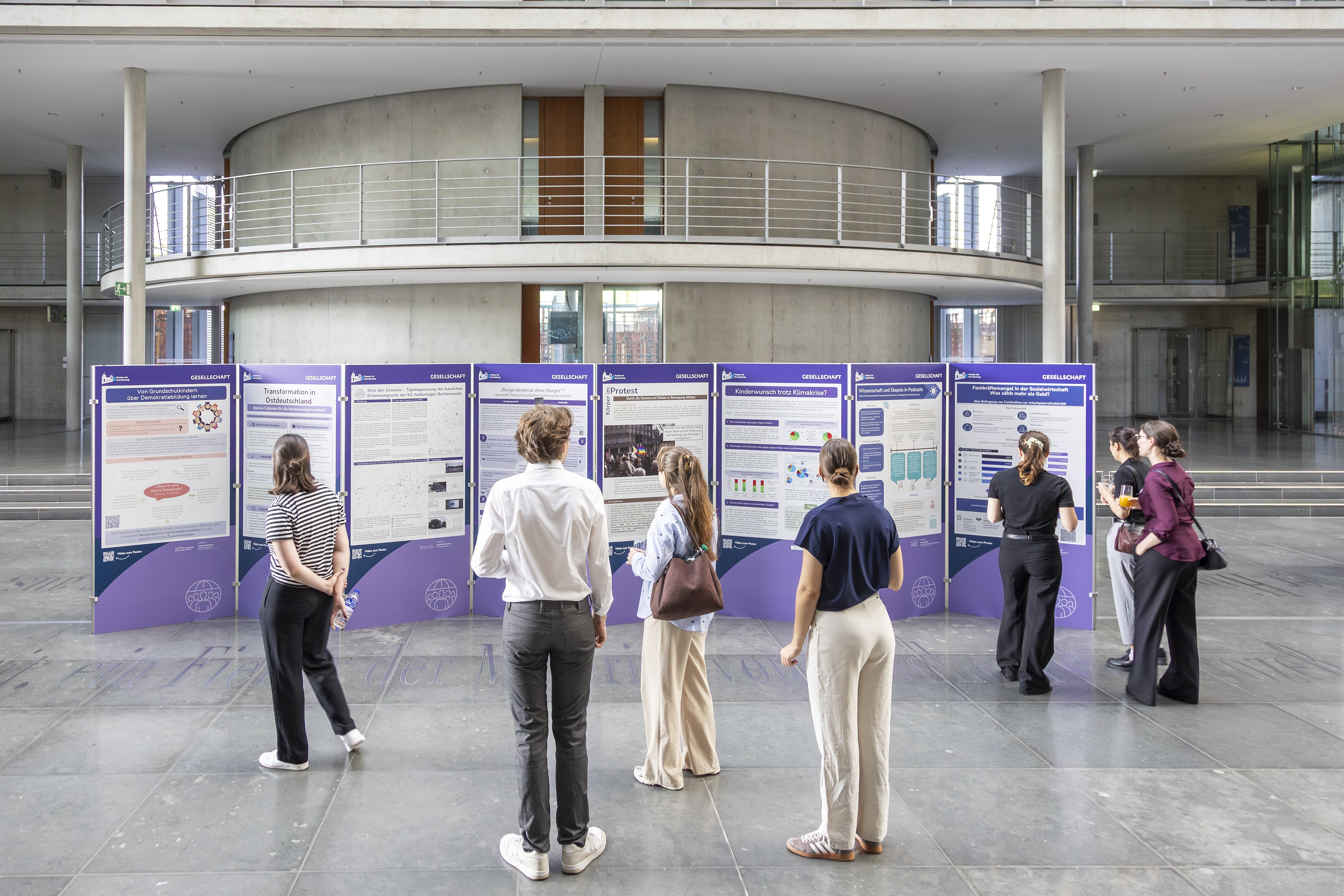
Poster im Bundestag showcased 44 undergraduate research projects from 28 universities across Germany under the theme Academic Freedom: The Freedom to Research (Wissenschaftsfreiheit: die Freiheit zu forschen). Selected by an independent jury, each contribution comprised a scientific poster and a short video.

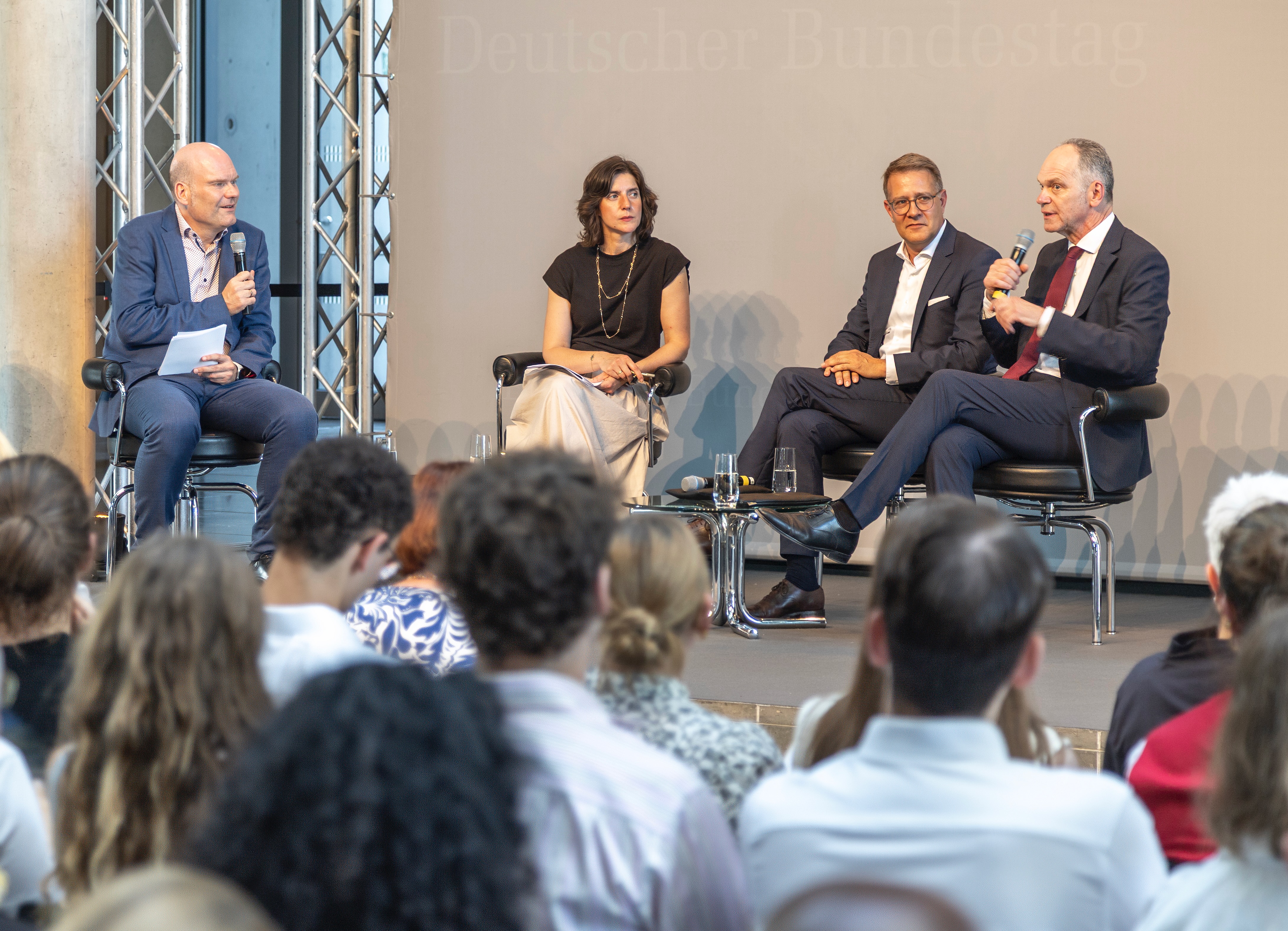
Vice-President of the German Bundestag Andrea Lindholz opened the exhibition on 25 June 2026 with an address highlighting academic freedom and the importance of student-led research. A panel discussion followed, featuring Prof. Dr. Ralph Bruder, President of the University of Oldenburg; Prof. Dr. Fatma Deniz, President of Technische Universität Berlin and a member of the Board of Directors of the Berlin University Alliance; and Adrian Grasse, a member of the German Bundestag and patron of the exhibition. Science journalist Dr. Jan-Martin Wiarda moderated the opening programme and later accompanied Andrea Lindholz as she visited several posters and spoke directly with participating students.

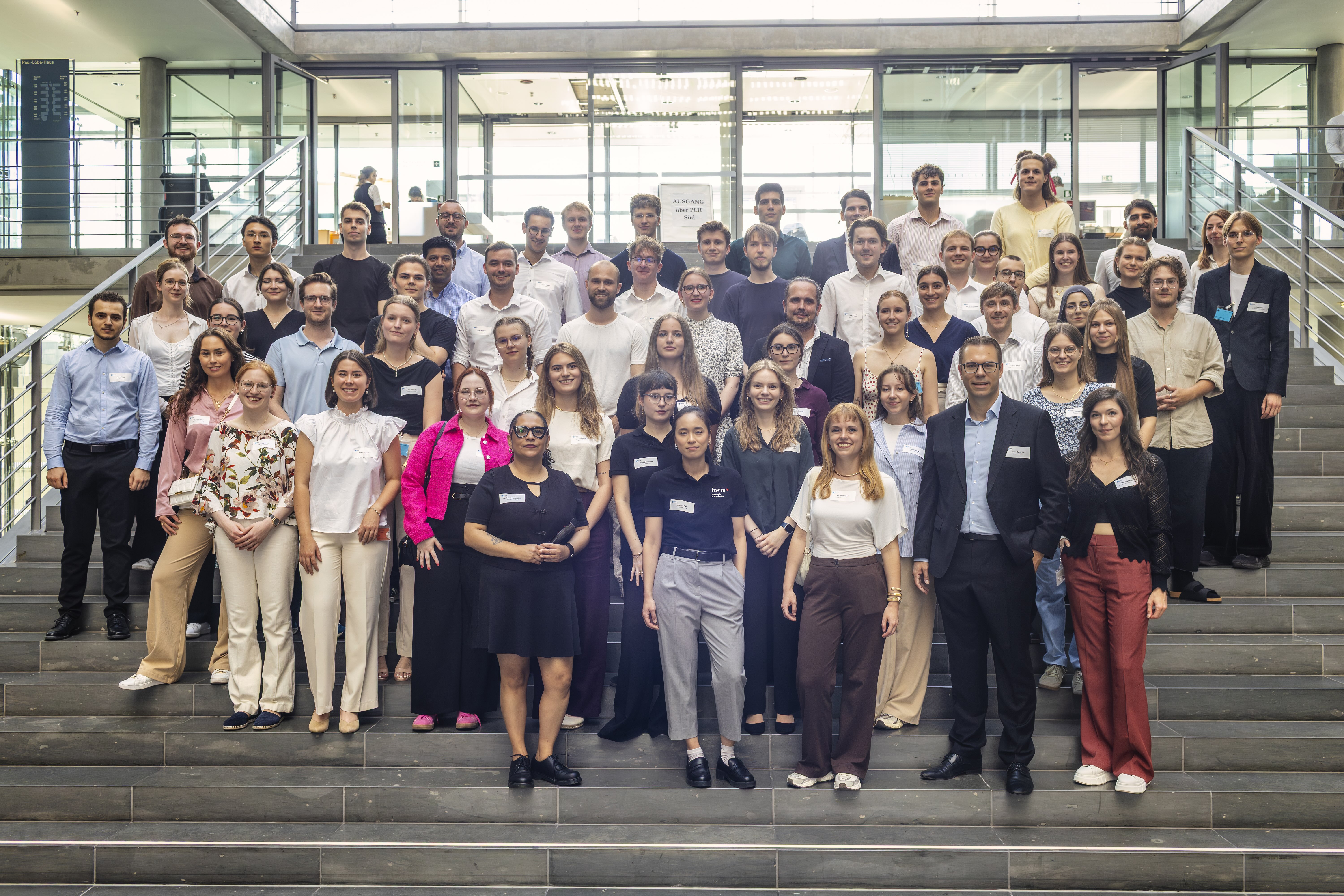
During the opening, students presented their research to parliamentarians, university leaders, fellow students and invited guests. These conversations allowed them to communicate their findings beyond academia and explore how research can contribute to political and public debate.

The posters remained on display in the Paul-Löbe-Haus until 17 July 2026.

“Academic freedom is a cornerstone of an open society.”
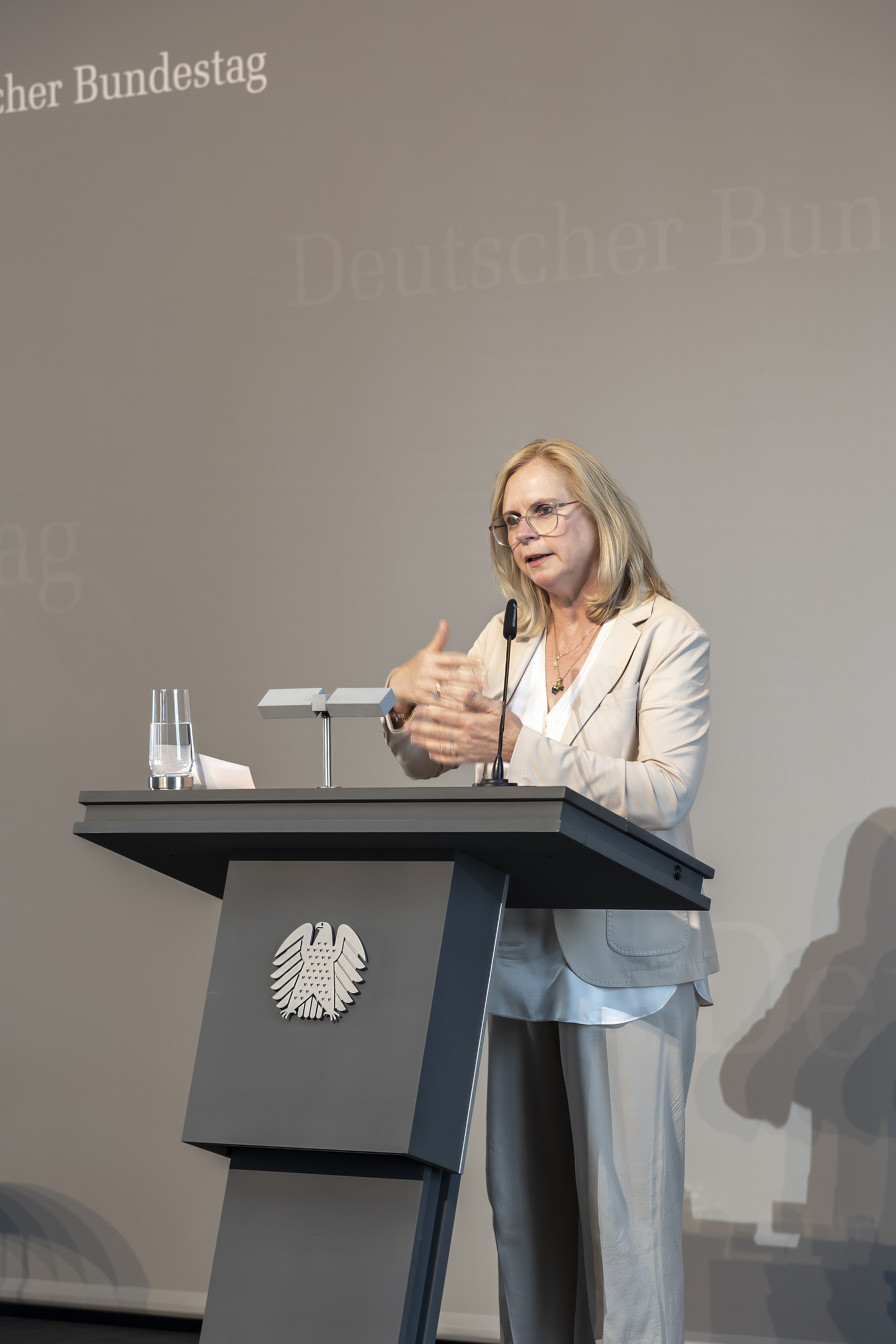
Adrian Grasse, Member of the German Bundestag and patron of the exhibition

Poster Exhibition

The exhibition was open to the public from 26 June to 17 July 2026, Monday to Friday, between 9:00 and 17:00 CEST. Entry was arranged on the hour, and visitors were required to register through the German Bundestag’s visitor form at least two working days before their visit.Public guided tours provided a closer introduction to the student research projects and the exhibition’s central theme, “Academic Freedom: The Freedom to Research.” Led by participating students together with Professor Harald Mieg, the project’s scientific adviser, the tours explained the research in an accessible way and placed the individual projects within the wider context of academic freedom, democratic engagement and knowledge exchange.The tours also created opportunities for discussion between students, researchers and visitors. They demonstrated how undergraduate research can contribute new perspectives to important scientific, political and societal questions.Poster im Bundestag presented undergraduate research from across Germany under the theme of academic freedom: freedom to research (Wissenschaftsfreiheit: die Freiheit zu forschen). An independent jury selected 44 projects from 28 universities across Germany. Each contribution consisted of a scientific poster and a short video, and the event language was German.

Research Across Eight Thematic Areas

Selected by an independent jury, the exhibition brought together 44 student research projects from universities and universities of applied sciences across Germany. Organised into eight thematic areas, the overview below presents each research topic alongside the student presenter or presenters and their institution.

Education

  • Lea Rieser (Universität Hamburg): Women in engineering
  • Ali Faruk Gönülalan and Hannah Reipen (Hochschule Hannover): Self-management, time management and stress management in study success
  • Iheb Belaiba (Jade Hochschule): Kirchhoff JS, a web-based simulation library
  • Miriam Brenzel (Universität Bremen): Measurement instruments and the development of inclusion
  • Pia Wolken (Carl von Ossietzky Universität Oldenburg): Cancer research in chemistry lessons

Digital Transformation and AI

  • Julian Leutz (Universität Hohenheim): ChatGPT as a tutor
  • Paula Magdalena Altmann and Marlene Bamberg (Freie Universität Berlin): Liability for AI errors in medicine
  • Eva Verena Keding (Carl von Ossietzky Universität Oldenburg): Students' acceptance of AI
  • Inken Isa Berlin (Universität Konstanz): AI in the search for active substances
  • Philipp Brauer (Charité Berlin): Chatbots for children's mental health
  • Daniel Kiss and Tom Eichelberger (Hasso Plattner Institute, Potsdam): AI to help save gorillas
  • Natalie Wesnigk (Hochschule Magdeburg-Stendal): AI and genuine participation

Diversity and Gender

  • Leonie-Sophie Volk-Wiegand (Frankfurt University of Applied Sciences): Women with a migration background in leadership positions
  • Anna Wobbe and Verónica Mota Galindo (Freie Universität Berlin): Trans* agency in media discourse
  • Carlotta Steimke (Carl von Ossietzky Universität Oldenburg): Political representation and identity

Energy

  • Jakob David Prieß and Rana Boylu (TU Berlin): Materials for batteries
  • Ruven Stünkel (HAWK Holzminden): Energy from drinking water
  • Torben Schaefer (Hochschule München): A hybrid lambda rotor for wind energy
  • Anton Atkins (TU Berlin): Electric vehicles as an energy reserve

Society

  • Leona Merth (Hochschule RheinMain): Skilled workers in the social economy
  • Rosalie Hoppe (Friedrich-Schiller-Universität Jena): Transformation in eastern Germany
  • Joshua Stolle (Carl von Ossietzky Universität Oldenburg): Science and scepticism in podcasts
  • Judith Thamm (Universität Münster): A Jewish memorial in Lippstadt
  • Ellen Reßmann (Leibniz Universität Hannover): The desire to have children and the climate crisis
  • Charlotte Paulzen (Universität Kassel): Built places of remembrance of concentration camp satellite sites
  • Mailin Holzkamp (Universität Münster): Democratic education through primary school children
  • Lea Paananen and Jules Mandel (Berlin University Alliance): Bodies in protest

Health

  • Anna Kischlat (HAW Hamburg): 3D imaging for the early detection of organ rejection
  • Moritz Lampkemeyer (Leibniz Universität Hannover): Cardiac supply under heat and physical activity
  • Annica Weigmann (Jade Hochschule): Caring for care workers
  • Ragnar Rabe and Sinan Aydin (UKE Hamburg): ECG training for recognising heart attacks
  • Tobias Kreusel and Julia Grigorjew (Universität Heidelberg): Synthetic immune cells
  • Maya Utermöhlen (Universität Göttingen): 3D cancer detection

Sustainability

  • Lena Susann Kroth and Jasper-Norwin Steven (TU Berlin): Lignin as a green resource
  • Nha-Dan Tran and Larissa Sina Oblong (Hochschule RheinMain): Gamification for sustainability
  • Julia Lüdemann (Leibniz Universität Hannover): Changes in cloud cover and the climate
  • Süheyla Fidan Yilmaz (Leibniz Universität Hannover): A segmented robotic arm for the deep sea
  • Luca Wilkening and Söhnke Siemers (Universität Bremen): Components made from Martian dust
  • Kiara Schumann (Universität Konstanz): The methyl effect for new active substances
  • Peter Röhrich (TH Köln): Removing organic pollutants from sediments
  • Alexander Weiss (Hochschule Ansbach): Plastics in local rivers

Politics and Law

  • Karim Walkusch and Pia Bergelt (Humboldt-Universität zu Berlin): UN-seen human rights
  • Emma Theresa Lucke (Universität Hamburg): Nuclear disarmament and verification
  • Hannah Diederich (Hochschule Hannover): Stance communication by US companies

Organising Partners

Poster im Bundestag was organised by the Carl von Ossietzky Universität Oldenburg in cooperation with the Berlin University Alliance. It is part of the Erasmus+ project Posters in Brussels (project number 2024-1-DE01-KA220-HED-000244662), co-funded by the European Union. Scientific advice: Prof. Dr. Harald Mieg, Humboldt-Universität zu Berlin.
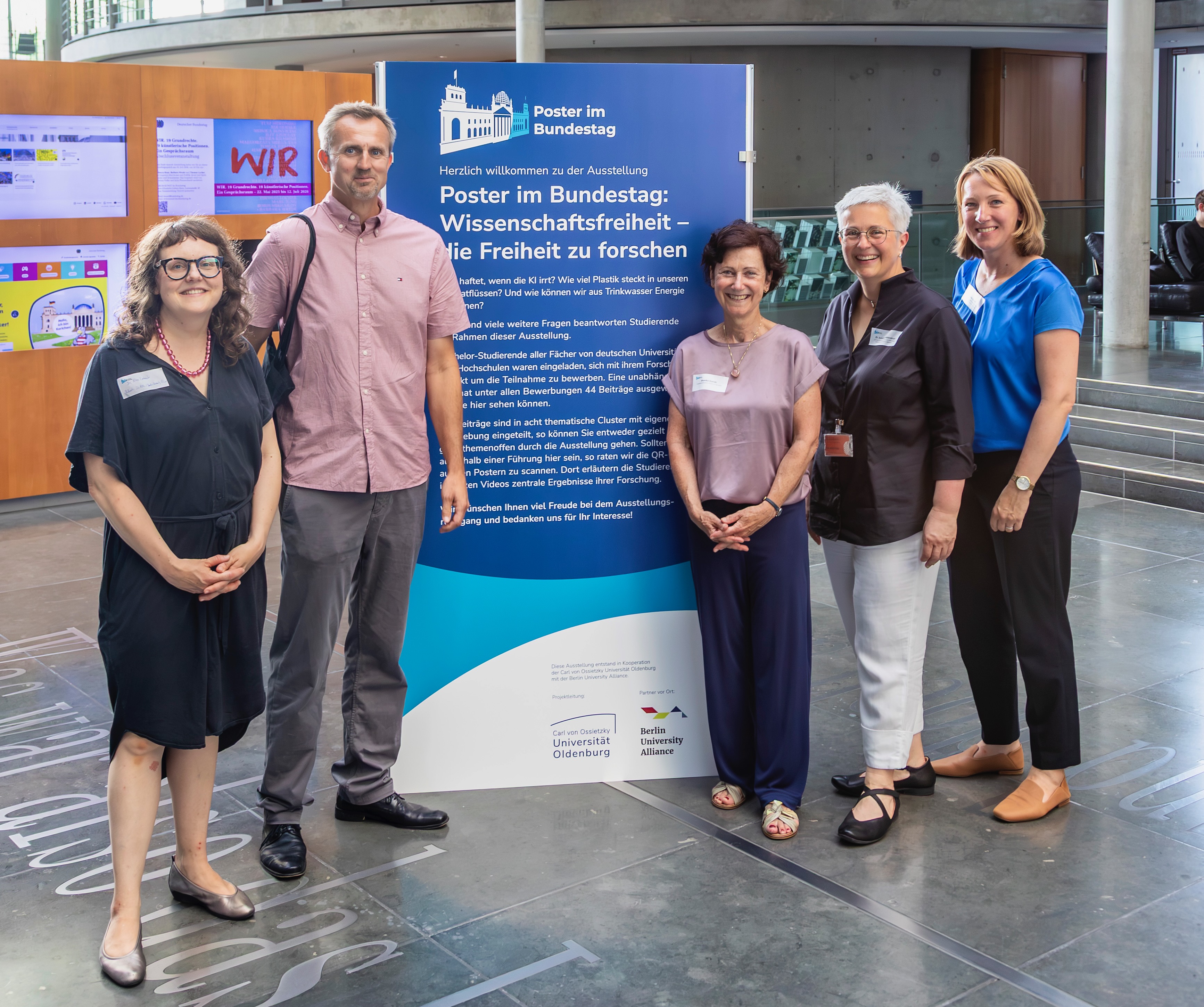
Contact details

Dr. Susanne Haberstroh, Monika Gurski and Christina Schaar, University of Oldenburg

Co-funded by the European Union logo
Funded by the European Union. Views and opinions expressed are however those of the author(s) only and do not necessarily reflect those of the European Union or the European Commission. Neither the European Union nor the granting authority can be held responsible for them.